

Artificial intelligence is transforming the way businesses manage everyday operations, making automation more accessible than ever before. Droven IO AI Automation Tools help organizations reduce repetitive work, improve accuracy, and accelerate decision-making through intelligent technology.
Whether you run a startup or a large enterprise, adopting an AI automation platform can streamline workflows, enhance customer experiences, and lower operational costs. As businesses continue embracing AI business automation, many are exploring Droven.io AI startup solutions and reading Droven.io reviews to identify reliable platforms. In this guide, you’ll discover how these automation tools work, their key benefits, real-world applications, and why they are becoming an essential part of modern digital business strategies.
.
What Are Droven IO AI Automation Tools?
Understanding AI-Powered Business Automation
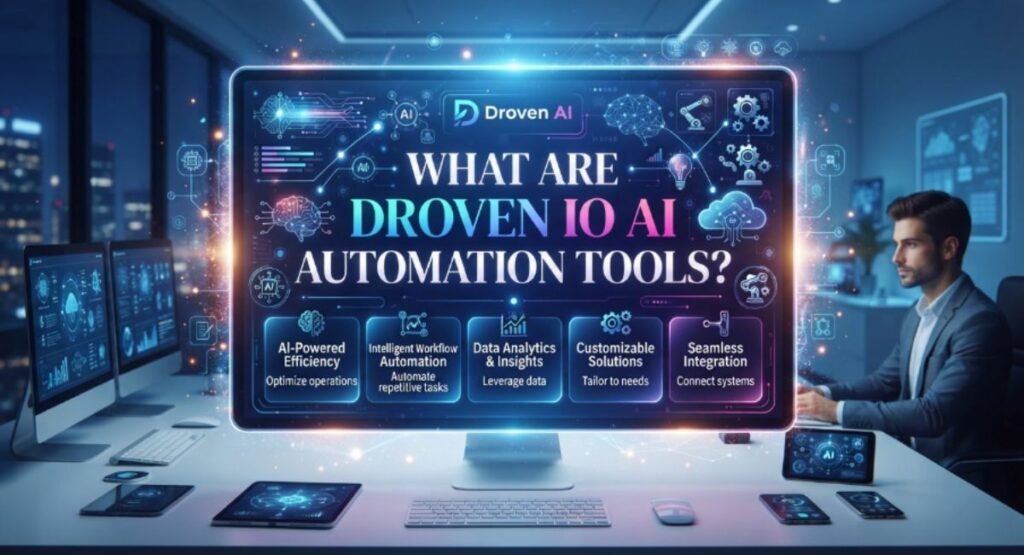
Droven IO AI Automation Tools describe intelligent technologies that automate routine business activities using Artificial Intelligence (AI), Machine Learning (ML), and Workflow Automation. Instead of depending on manual effort for repetitive work, these tools process information, complete actions, and improve decisions with minimal human involvement. This approach helps businesses save time while increasing consistency across departments.
Modern organizations create thousands of tasks every day. Customer emails, invoices, employee requests, reports, and sales updates quickly become difficult to manage manually. An advanced AI automation platform simplifies these operations by learning from business data and recommending faster ways to complete work. Unlike traditional software, intelligent systems become more effective as they receive more information.
How Droven IO AI Automation Tools Differ from Traditional Automation
Traditional automation follows fixed rules. If something unexpected happens, the process often stops until someone steps in. Droven IO AI Automation Tools, however, combine Machine Learning (ML) with Business Intelligence to recognize patterns, adapt to new situations, and improve workflows over time. This flexibility makes automation more valuable in today’s fast-changing business environment.
Imagine a customer support team handling hundreds of requests every day. Basic automation can route emails to different folders. Intelligent automation goes much further. It understands customer intent, suggests responses, prioritizes urgent requests, and continuously improves future recommendations. This difference turns ordinary automation into true Intelligent automation.
Core Technologies Behind Intelligent Automation
Several advanced technologies work together inside modern automation systems. Predictive Analytics helps forecast future trends by examining historical information. Intelligent Document Processing extracts useful data from contracts, invoices, and reports without requiring manual entry. These capabilities allow businesses to process information quickly while reducing costly human errors.
At the same time, Business workflow automation connects departments through automated approvals, notifications, and task management. Combined with AI workflow management, organizations gain complete visibility into operations while improving communication between teams. This creates smoother business processes from start to finish.
Why Businesses Are Searching for Droven IO AI Automation Tools
Business leaders want technology that delivers measurable results instead of creating additional complexity. Interest in Droven IO AI Automation Tools continues to grow because organizations need flexible Automation software capable of improving productivity without replacing experienced employees. Most companies view automation as a way to support people rather than remove them from the workplace.
Many decision-makers also search for Droven.io reviews before choosing an automation solution. They often compare ease of use, scalability, integration options, and long-term value. As the Droven.io AI startup ecosystem continues to evolve, businesses expect solutions that combine innovation with practical results for everyday operations.
Why AI Automation Matters for Modern Businesses
Rising Demand for Intelligent Business Operations
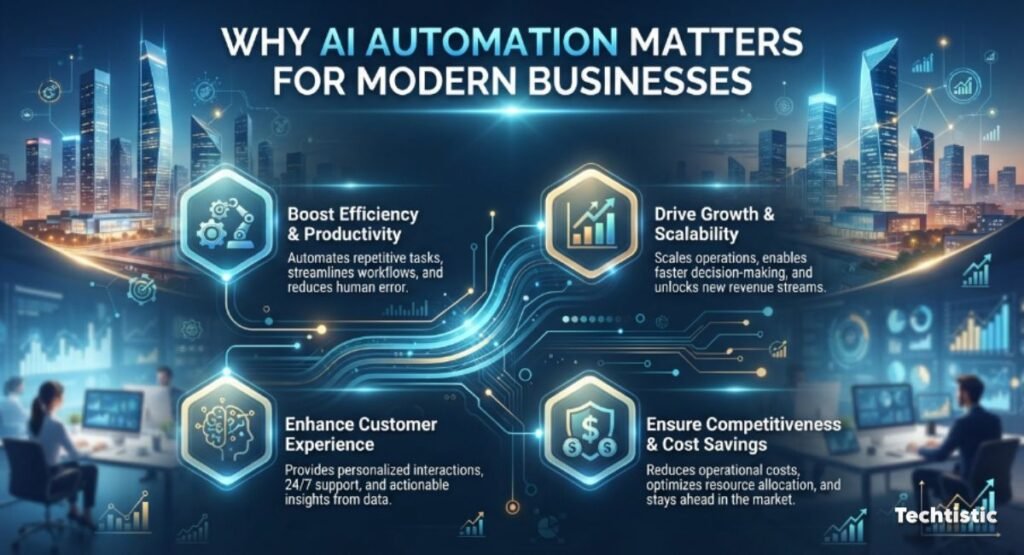
Competition moves faster than ever. Customers expect instant responses, employees expect efficient systems, and business owners expect higher productivity. Companies can no longer rely on outdated manual processes if they want to stay competitive. AI business automation helps organizations meet these expectations without dramatically increasing operational costs.
Digital transformation is no longer a future goal. It has become an immediate business priority. Companies investing in Digital Transformation often begin with workflow automation because it delivers visible improvements within a short period. Automating repetitive activities also reduces employee frustration, allowing teams to focus on creative and strategic work.
How AI Improves Productivity and Operational Efficiency
Every minute spent on repetitive tasks reduces time available for innovation. Droven IO AI Automation Tools eliminate routine work by automating approvals, document handling, reporting, scheduling, and customer communication. Employees spend less time performing repetitive actions and more time solving business problems that require human judgment.
For example, a finance department processing hundreds of invoices each month can automate document recognition, approval routing, and payment tracking. Instead of spending hours reviewing paperwork, staff members receive organized information and only intervene when exceptions occur. This approach increases speed while maintaining high accuracy.
Reducing Costs While Scaling Faster
Growing businesses often struggle with increasing workloads. Hiring additional employees for every new process quickly becomes expensive. Intelligent automation allows organizations to handle larger volumes of work without proportionally increasing operational expenses. This makes business growth more sustainable over the long term.
Cloud-based Automation Platform solutions also allow companies to expand automation gradually. A business might begin by automating customer service before extending automation into finance, marketing, or human resources. This phased strategy minimizes disruption while maximizing return on investment.
The Role of AI in Digital Transformation
Modern digital transformation depends on more than simply replacing paper with software. Successful organizations combine Enterprise Software, automation, analytics, and intelligent decision-making into one connected ecosystem. This integration creates faster communication, better reporting, and improved customer experiences.
The growing discussion around the Droven IO future of AI reflects this broader movement toward intelligent organizations. Businesses increasingly want automation that learns, adapts, and continuously improves instead of following rigid instructions. As AI technologies continue advancing, intelligent automation will become a core part of everyday business operations rather than an optional advantage.
| Traditional Operations | AI-Driven Operations |
| Manual data entry | Automated data processing |
| Slow approvals | Instant workflow approvals |
| Reactive decisions | Predictive Analytics insights |
| Paper-based documents | Intelligent Document Processing |
| Limited reporting | Real-time Business Intelligence dashboards |
| Human-only workflows | Workflow Automation with AI assistance |
Key Features of Droven IO AI Automation Tools
Intelligent Workflow Automation
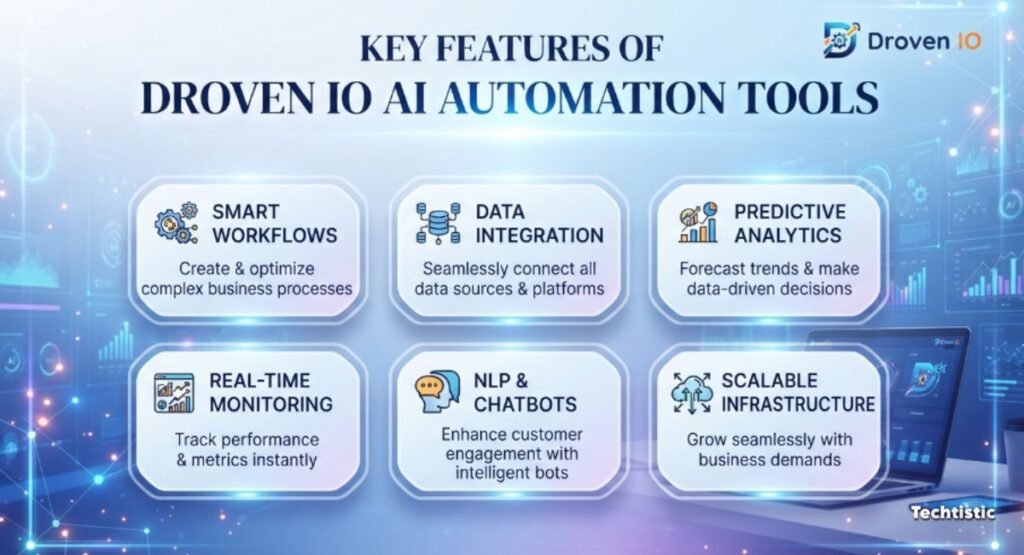
One of the strongest capabilities of Droven IO AI Automation Tools is intelligent workflow management. Instead of assigning tasks manually, businesses create automated processes that move work between departments according to predefined rules and AI recommendations. This reduces delays while improving accountability across the organization.
For instance, when a customer submits an online request, the system can automatically verify information, notify the appropriate department, assign deadlines, and monitor progress until completion. This level of Business workflow automation creates smoother experiences for both employees and customers.
AI-Powered Data Processing and Analysis
Businesses generate enormous amounts of information every day. Emails, spreadsheets, invoices, contracts, and customer interactions all contain valuable insights. Manual analysis often consumes significant time while increasing the risk of mistakes. Artificial Intelligence (AI) processes this information quickly and consistently.
Using Machine Learning (ML), automation systems identify trends, organize business records, classify documents, and highlight unusual patterns. Managers receive meaningful insights instead of spending hours searching through raw data. Better information leads to better business decisions.
Smart Document Management
Documents remain essential for every business. Contracts, financial reports, purchase orders, employee records, and invoices require accurate handling. Intelligent Document Processing automates document classification, extracts important information, verifies data, and routes files to the correct department without unnecessary manual work.
Consider a healthcare provider processing patient forms every day. Instead of entering information manually, intelligent automation extracts details, validates records, and securely updates databases. This improves efficiency while supporting regulatory compliance and reducing administrative workload.
Predictive Analytics and Forecasting
Successful businesses don’t simply react to problems. They prepare for future opportunities. Predictive Analytics helps organizations forecast demand, estimate sales, identify customer behavior, and manage inventory using historical and real-time data.
Retail companies, for example, can anticipate seasonal buying patterns before demand increases. Manufacturers can schedule maintenance before equipment fails. Financial teams can identify spending trends before budgets become difficult to manage. These predictive capabilities reduce uncertainty while supporting smarter planning.
Business Intelligence Dashboards
Executives depend on accurate information when making strategic decisions. Automated dashboards collect business metrics from multiple systems and present them in one easy-to-understand view. Instead of building reports manually, organizations receive live updates throughout the day.
Through integrated Business Intelligence, managers can monitor sales performance, customer satisfaction, employee productivity, and financial health from a single location. Real-time reporting allows leaders to respond quickly whenever conditions change.
CRM, ERP, and Third-Party Integrations
Modern businesses rarely depend on one software application. Sales teams use CRM platforms while finance departments rely on ERP systems and customer support teams operate help desk software. A flexible AI automation platform connects these systems so information flows automatically without repeated manual entry.
This integration improves data consistency and reduces communication gaps between departments. Employees no longer waste time transferring information from one system to another because automation performs the work behind the scenes.
No-Code and Low-Code Automation
Not every organization has a large technical team. No-code and low-code automation platforms allow employees to create workflows through visual interfaces instead of complex programming. This approach makes automation accessible to businesses of every size.
Marketing teams can automate campaign approvals. Human resources can simplify employee onboarding. Finance departments can automate invoice processing. All of this becomes possible without extensive software development projects.
AI Agents and Virtual Assistants
The newest generation of Droven IO AI Automation Tools includes intelligent AI agents capable of supporting employees throughout the workday. These assistants answer questions, schedule meetings, retrieve business information, generate reports, and recommend actions based on business data.
As the Droven.io AI startup landscape continues expanding, intelligent assistants are becoming central to workplace productivity. Rather than replacing employees, they act as reliable digital partners that help teams work faster, smarter, and with greater confidence.
How Droven IO AI Automation Tools Work
Step-by-Step Automation Workflow
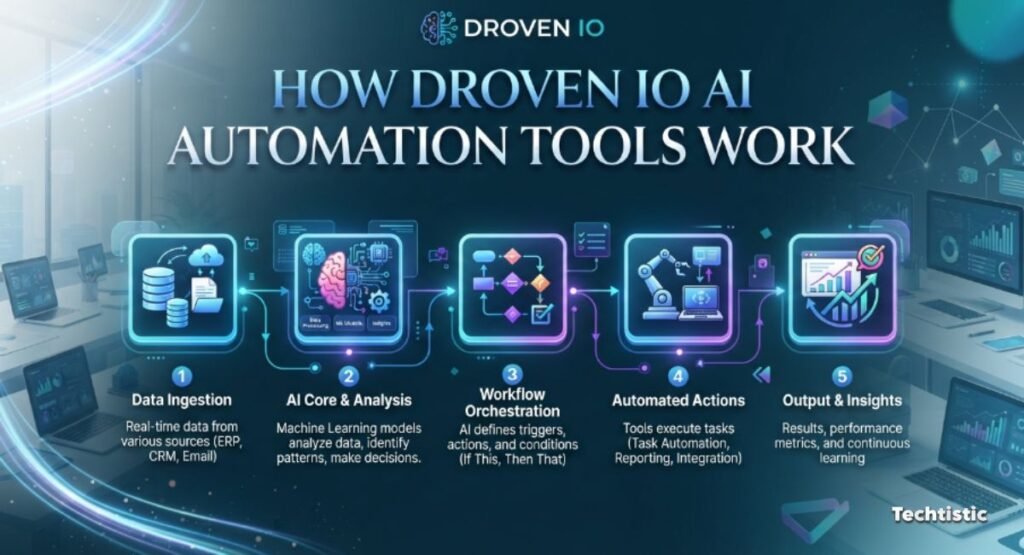
Every successful automation process begins with a clear workflow. Droven IO AI Automation Tools collect information from different business systems before analyzing it through Artificial Intelligence (AI). The platform then decides what action to take based on predefined rules and real-time insights. This approach removes repetitive work and keeps operations moving without unnecessary delays.
The process doesn’t stop after one task. Modern Workflow Automation continuously monitors each step and updates workflows as new information arrives. Instead of depending on manual supervision, businesses receive a connected system that works around the clock. This creates a smoother experience for employees while reducing operational bottlenecks.
Collecting and Processing Business Data
Every business generates valuable data through customer interactions, invoices, emails, forms, and transactions. An advanced AI automation platform gathers this information from multiple sources before organizing it into structured records. This eliminates duplicate work and keeps business information accurate.
Once data enters the system, Intelligent Document Processing identifies important details automatically. Rather than asking employees to review hundreds of documents, the software extracts names, dates, invoice numbers, and other essential information within seconds. Faster processing also reduces costly human errors.
AI Decision-Making and Machine Learning
Unlike traditional software, intelligent automation doesn’t simply follow fixed instructions. Machine Learning (ML) allows automation systems to recognize patterns and improve decisions over time. The more business data the system processes, the better it becomes at predicting outcomes and recommending actions.
For example, an online retailer can use automation to identify customers who may abandon their shopping carts. Instead of waiting for lost sales, the system can automatically send personalized reminders or special offers. This proactive approach improves customer engagement while increasing revenue.
Continuous Learning and Workflow Optimization
Business environments change every day. Customer preferences evolve, market conditions shift, and operational priorities move quickly. Droven IO AI Automation Tools adapt by learning from previous workflows instead of relying on static rules. This flexibility helps organizations remain competitive without constantly redesigning automation processes.
The combination of AI workflow management and Business Intelligence provides managers with valuable insights into workflow performance. They can identify delays, measure productivity, and improve operations using real-time data instead of assumptions.
Real-World Automation Example
Imagine a healthcare clinic receiving hundreds of appointment requests every week. Without automation, employees manually verify patient details, schedule appointments, send reminders, and update records. This process consumes valuable time while increasing the possibility of mistakes.
Using Droven IO AI Automation Tools, appointment requests enter the system automatically. Patient information is verified, available time slots are suggested, reminders are sent, and records are updated without additional staff involvement. Employees spend more time helping patients instead of completing repetitive administrative tasks.
| Automation Stage | Business Result |
| Data Collection | Faster information gathering |
| AI Analysis | Smarter decision-making |
| Workflow Execution | Reduced manual effort |
| Performance Monitoring | Continuous improvement |
| Reporting | Real-time business insights |
Best Use Cases Across Different Industries
Healthcare and Medical Administration
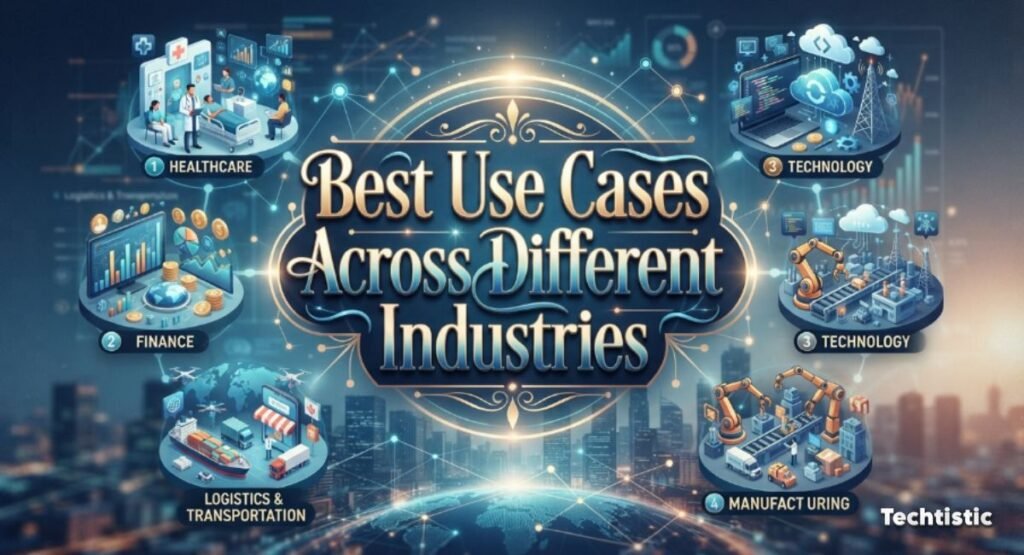
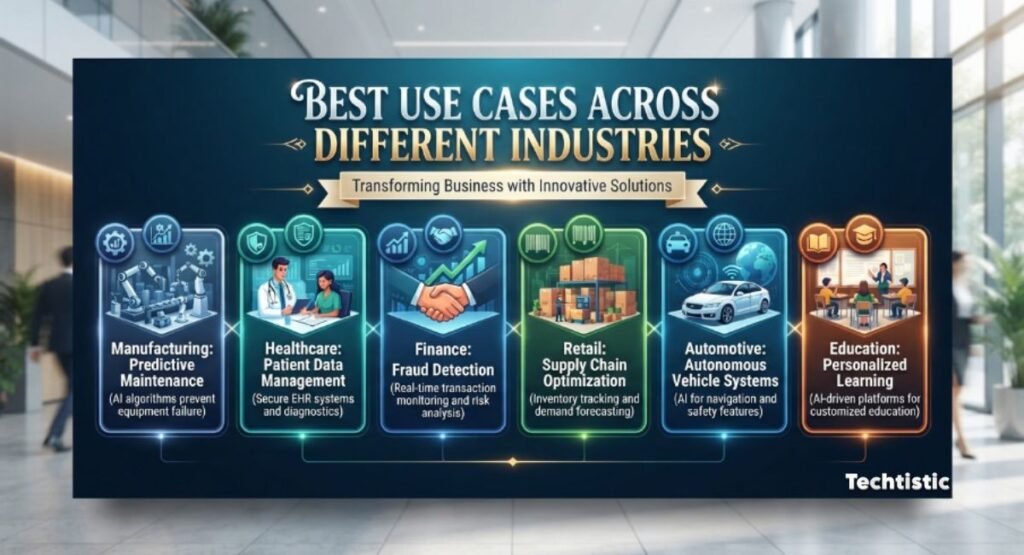
Healthcare organizations manage thousands of records every day. AI business automation simplifies appointment scheduling, insurance verification, medical documentation, and patient communication. These improvements allow healthcare professionals to focus more on patient care rather than administrative paperwork.
Hospitals also benefit from Predictive Analytics, which helps forecast patient demand, manage staffing levels, and optimize medical resources. Better planning improves operational efficiency while supporting higher standards of care.
Banking and Financial Services
Financial institutions process large volumes of sensitive information every day. Automation helps banks accelerate loan approvals, monitor suspicious transactions, and improve compliance reporting. These improvements increase accuracy while reducing operational risks.
Many financial organizations also combine Robotic Process Automation (RPA) with Artificial Intelligence (AI) to automate customer onboarding, document verification, and fraud detection. This combination creates faster and more secure financial services.
Retail and E-commerce
Retail businesses operate in highly competitive markets where customer experience directly influences sales. Business workflow automation helps manage inventory, process orders, track shipments, and deliver personalized product recommendations without increasing manual workload.
Retailers also rely on Machine Learning (ML) to analyze customer behavior and predict future buying patterns. These insights support smarter pricing strategies while improving customer satisfaction throughout the purchasing journey.
Manufacturing and Supply Chain
Manufacturers depend on efficiency to remain profitable. Droven IO AI Automation Tools monitor equipment performance, automate quality inspections, and optimize inventory management. These capabilities reduce downtime while improving production accuracy.
Supply chain teams also benefit from Business Intelligence dashboards that provide real-time visibility into inventory levels, supplier performance, and delivery schedules. Better information leads to faster operational decisions.
Human Resources and Recruitment
Hiring new employees involves repetitive administrative work. Automation simplifies resume screening, interview scheduling, onboarding documentation, payroll processing, and employee record management. Human resource teams save valuable time while creating better experiences for job candidates.
Intelligent automation also supports employee development by tracking training progress and identifying skill gaps. This helps organizations build stronger workforces without increasing administrative effort.
Marketing and Sales Automation
Marketing departments generate large amounts of customer data every day. Automation organizes leads, personalizes email campaigns, schedules follow-ups, and tracks campaign performance automatically. Sales teams spend more time building relationships instead of updating spreadsheets.
With AI workflow management, businesses can identify high-value prospects based on purchasing behavior and engagement history. This allows sales representatives to focus their efforts where they are most likely to achieve success.
Customer Support and Service
Customer expectations continue rising. People want immediate responses regardless of the time of day. Intelligent automation allows businesses to provide faster support through AI-powered chat systems, automated ticket routing, and personalized recommendations.
Instead of replacing customer service representatives, automation handles routine questions while forwarding complex issues to human agents. This balance improves customer satisfaction and reduces response times.
Logistics and Transportation
Logistics companies coordinate shipments across multiple locations every day. Automation optimizes delivery routes, tracks shipments, manages warehouse inventory, and predicts transportation delays before they affect customers.
The growing interest in Droven.io RPA and business automation reflects the logistics industry’s need for faster operations and better visibility. Organizations using intelligent automation often reduce delivery delays while improving overall supply chain performance.
Benefits of Using Droven IO AI Automation Tools
Increased Productivity
One of the greatest advantages of Droven IO AI Automation Tools is improved productivity. Employees no longer spend hours completing repetitive tasks because automation performs routine work quickly and consistently. Teams gain more time to focus on innovation, customer relationships, and strategic planning.
Small improvements across multiple departments create significant long-term results. Even saving a few minutes on everyday tasks adds up to hundreds of productive hours over an entire year.
Faster Business Processes
Manual approvals often slow business operations. Intelligent automation moves requests instantly between departments without waiting for paper documents or email confirmations. Faster workflows improve collaboration while reducing unnecessary delays.
Organizations using an advanced Automation Platform can also monitor every stage of a workflow in real time. Managers quickly identify bottlenecks and make improvements before productivity declines.
Lower Operational Costs
Hiring additional employees isn’t always the best solution for increasing workloads. Automation allows businesses to scale operations while controlling labor expenses. Repetitive administrative work becomes less expensive without reducing service quality.
Many organizations searching for Droven.io reviews want proof that automation delivers measurable savings. In many cases, businesses report lower operating costs after automating high-volume processes such as invoice handling, reporting, and customer communication.
Better Customer Experience
Customers value speed, accuracy, and personalized service. Intelligent automation supports all three by reducing waiting times and providing consistent responses across multiple communication channels. Faster service often leads to higher customer satisfaction and stronger brand loyalty.
For example, automated order updates, appointment reminders, and personalized recommendations create a smoother customer journey without increasing employee workload.
Improved Decision-Making
Good decisions depend on accurate information. Business Intelligence dashboards collect live business data and transform it into meaningful reports. Leaders no longer rely on outdated spreadsheets because automation continuously updates performance metrics.
When combined with Predictive Analytics, decision-makers can anticipate future opportunities instead of simply reacting to problems after they occur. This proactive approach strengthens long-term business planning.
Enhanced Data Accuracy
Manual data entry often creates inconsistencies that affect reporting and customer service. Automation validates information automatically before storing it within business systems. Cleaner data leads to more reliable reports and better operational performance.
By reducing repetitive manual work, organizations also minimize costly errors that could affect compliance, financial reporting, or customer satisfaction.
Greater Business Scalability
As companies grow, workloads increase rapidly. Intelligent automation supports expansion without requiring proportional increases in staffing. Businesses can process more transactions, serve more customers, and manage larger operations using the same core automation infrastructure.
This flexibility explains why many experts believe the Droven IO future of AI will center on scalable automation that adapts to changing business needs rather than fixed software solutions.
Higher Return on Investment (ROI)
Automation represents a long-term investment rather than a short-term expense. Businesses often experience savings through improved productivity, reduced operational costs, faster workflows, and better customer experiences. These combined benefits strengthen profitability over time.
Organizations evaluating a Droven.io AI startup solution usually compare expected ROI alongside usability, scalability, and integration capabilities. Companies that begin with small automation projects often expand adoption after seeing measurable business improvements.
| Business Challenge | Automation Benefit |
| Repetitive manual tasks | Higher productivity |
| Slow approvals | Faster workflows |
| Human errors | Better data accuracy |
| Rising labor costs | Lower operational expenses |
| Poor visibility | Real-time Business Intelligence |
| Business growth | Improved scalability |
| Delayed decisions | Predictive Analytics insights |
| Customer service delays | Faster and more personalized support |
Droven IO AI Automation Tools vs Traditional Business Processes
AI Automation vs Manual Workflows
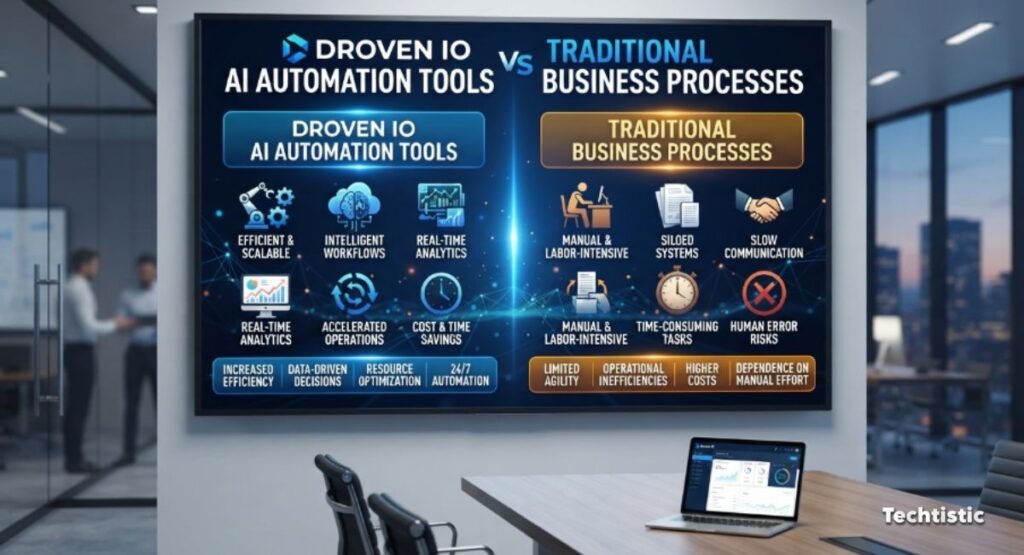
Many businesses still depend on manual processes because they seem familiar. However, manual work often slows operations and increases the chance of mistakes. Droven IO AI Automation Tools replace repetitive tasks with smart systems that complete work faster while maintaining consistent quality. Employees spend less time on administration and more time creating value for customers.
Manual workflows also make it difficult to scale. As workloads increase, companies usually need more staff to keep up. In contrast, an AI automation platform grows alongside the business. Automation handles larger volumes of work without reducing speed or accuracy, making long-term growth more manageable.
AI Automation vs Robotic Process Automation (RPA)
Many people confuse Robotic Process Automation (RPA) with AI automation. Although both improve efficiency, they solve different business problems. Robotic Process Automation (RPA) follows predefined instructions to perform repetitive actions. It works well for structured tasks that rarely change.
Artificial Intelligence (AI) adds another layer of intelligence. It understands information, recognizes patterns, and learns from experience through Machine Learning (ML). When businesses combine AI with Droven.io RPA and business automation, they create smarter systems that adapt to changing situations rather than simply repeating instructions.
Feature Comparison Table
The differences between traditional processes and intelligent automation become easier to understand when viewed side by side.
| Feature | Droven IO AI Automation Tools | Traditional Business Processes |
| Speed | Real-time processing | Manual and slower |
| Accuracy | High with AI learning | Human errors are common |
| Scalability | Expands with business growth | Requires additional staff |
| Decision Making | Predictive Analytics insights | Based on manual reports |
| Reporting | Live Business Intelligence dashboards | Periodic manual reports |
| Document Handling | Intelligent Document Processing | Paper-based or manual entry |
| Availability | 24/7 automation | Limited working hours |
| Cost Efficiency | Lower long-term costs | Higher operating expenses |
Which Approach Fits Your Business?
The right solution depends on your business goals. Smaller companies may begin with simple automation for invoices or customer support. Larger organizations often automate several departments at the same time to improve collaboration and reduce operational costs. Starting with one process allows teams to build confidence before expanding automation further.
Business leaders researching Droven.io reviews usually compare ease of implementation, flexibility, and long-term value before making a decision. Choosing software that grows with your company often delivers greater returns than selecting a system designed only for current needs.
When Hybrid Automation Delivers Better Results
Many successful organizations combine manual expertise with intelligent technology. Employees continue making strategic decisions while automation manages repetitive work. This balanced approach increases productivity without removing the human judgment needed for complex situations.
For example, an insurance company may automate claim collection and document verification while allowing specialists to review unusual cases. This hybrid model combines the speed of automation with the experience of skilled professionals, creating a stronger overall business process.
How to Choose the Right AI Automation Tool
Define Your Business Goals
Every automation project should begin with a clear objective. Some businesses want to improve customer service while others focus on reducing operating costs or increasing productivity. Defining measurable goals helps organizations choose the right solution and evaluate future success more effectively.
Rather than automating everything immediately, start with one high-impact process. Early success builds confidence and provides valuable experience before expanding automation into other business areas.
Evaluate Automation Features
Different platforms offer different capabilities. Businesses should compare workflow design, reporting tools, AI capabilities, integrations, and customization options before selecting an Automation Platform. The right features should solve existing business problems instead of creating unnecessary complexity.
Organizations should also examine how well the software supports Workflow Automation, Business workflow automation, and AI workflow management. Flexible features ensure the system remains useful as business requirements change.
Check Integration Capabilities
Modern companies rely on multiple software applications every day. Automation becomes much more valuable when it connects with CRM systems, ERP platforms, accounting software, communication tools, and cloud services. Strong integrations eliminate duplicate work while improving data consistency.
Businesses should verify compatibility before purchasing any solution. Smooth integration reduces implementation time and allows employees to continue using familiar software while benefiting from automation.
Assess Security and Compliance
Business data is one of an organization’s most valuable assets. Companies should evaluate encryption standards, user access controls, backup procedures, and compliance certifications before adopting an automation solution. Strong security protects sensitive customer and financial information.
Industries such as healthcare and finance must also follow strict regulations. Selecting secure Enterprise Software with reliable compliance features reduces legal risks while protecting business reputation.
Consider Pricing and Scalability
The least expensive platform isn’t always the best investment. Businesses should compare licensing costs, maintenance expenses, implementation fees, and future expansion options. A scalable solution often delivers greater long-term value than software designed only for current operations.
The growing interest in the Droven IO future of AI highlights the importance of choosing technology that evolves alongside business growth. Flexible platforms reduce the need for costly software replacements later.
Compare Vendor Support and Reliability
Technology performs best when reliable support is available. Businesses should review documentation, training resources, customer service quality, and software updates before selecting a provider. Strong vendor support reduces downtime and helps employees adapt more quickly.
Many organizations also study Droven.io AI startup developments to understand how emerging providers compare with established software vendors. Continuous innovation often leads to more flexible automation solutions.
Questions to Ask Before Investing
Before purchasing any automation solution, decision-makers should evaluate whether the platform truly fits their organization. Asking the right questions reduces implementation risks and improves long-term satisfaction.
| Evaluation Question | Why It Matters |
| Can it automate our biggest challenges? | Maximizes business impact |
| Does it integrate with existing software? | Prevents workflow disruption |
| Is employee training simple? | Encourages faster adoption |
| Can it scale as we grow? | Supports long-term expansion |
| Does it provide strong security? | Protects business data |
| Is customer support reliable? | Reduces implementation risks |
Common Challenges, Risks, and Best Practices
Data Privacy and Cybersecurity
Automation systems process large amounts of sensitive business information. Customer records, financial documents, employee details, and confidential reports require strong protection. Companies should implement encryption, secure authentication, and regular security audits to safeguard valuable data.
Cybersecurity should remain an ongoing priority instead of a one-time project. Regular software updates and employee awareness training help reduce vulnerabilities while strengthening overall business resilience.
Integration with Legacy Systems
Many organizations still use older software that wasn’t designed for modern automation. Connecting these systems can create technical challenges during implementation. Careful planning helps businesses avoid unexpected delays while maintaining daily operations.
Working with experienced implementation teams often simplifies complex integrations. Gradual deployment also allows businesses to resolve issues before expanding automation across multiple departments.
Employee Training and Adoption
Technology succeeds only when employees understand how to use it. Some workers initially worry that automation will replace their jobs. In reality, intelligent automation usually removes repetitive work while allowing employees to focus on creative and strategic responsibilities.
Clear communication, practical training, and ongoing support encourage successful adoption. Employees who understand the benefits of automation often become its strongest advocates.
Managing AI Bias and Accuracy
Automation systems learn from available data. If historical information contains errors or bias, AI recommendations may also become inaccurate. Organizations should regularly review system performance to ensure fair and reliable decision-making.
Businesses should combine Artificial Intelligence (AI) with human oversight whenever important financial, legal, or customer decisions are involved. This balanced approach improves both accuracy and accountability.
Governance and Compliance
Responsible automation requires clear policies that define how AI systems collect, process, and store information. Organizations should establish governance frameworks that support transparency, accountability, and regulatory compliance.
Companies operating internationally may also need to follow multiple privacy regulations. Strong governance protects customers while reducing operational and legal risks.
Best Practices for Successful AI Automation
Businesses achieve better results when automation follows a structured implementation strategy. Successful organizations begin with clearly defined goals, automate high-volume tasks, monitor performance continuously, and improve workflows based on measurable results.
Regular performance reviews supported by Business Intelligence help managers identify opportunities for further optimization. Continuous improvement ensures automation remains aligned with changing business priorities.
Common Mistakes Businesses Should Avoid
One common mistake is attempting to automate every process at once. Large projects often become difficult to manage and increase implementation risks. A gradual approach usually delivers faster results while minimizing disruption.
Another mistake involves focusing only on technology instead of people. Automation should enhance employee productivity rather than replace collaboration and expertise. Organizations that balance intelligent systems with skilled professionals often achieve the most sustainable long-term success.
Getting Started with Droven IO AI Automation Tools
Assess Current Business Processes
Every successful automation journey starts with understanding how your business operates today. Review daily tasks and identify activities that consume time without adding significant value. Repetitive work such as invoice processing, customer inquiries, report generation, and data entry usually offers the best starting point for Droven IO AI Automation Tools.
Before introducing automation, document each workflow from beginning to end. This simple exercise reveals unnecessary steps, duplicated effort, and communication gaps. Once you understand your current processes, implementing an AI automation platform becomes much easier and produces faster results.
Identify High-Impact Automation Opportunities
Not every task should be automated immediately. Businesses achieve better outcomes by focusing first on repetitive processes that require minimal human judgment. Customer support, appointment scheduling, document management, and internal approvals often deliver quick wins with measurable improvements.
Starting with one department also reduces implementation risks. Early success builds employee confidence and creates a clear roadmap for expanding AI business automation across finance, sales, marketing, operations, and human resources.
Build an AI Implementation Roadmap
A structured implementation plan helps businesses avoid unnecessary delays. Begin by setting clear objectives, defining success metrics, assigning responsibilities, and creating realistic timelines. Strong planning keeps every department aligned throughout the automation journey.
Organizations should also determine how success will be measured. Productivity improvements, reduced processing time, cost savings, customer satisfaction, and operational accuracy provide meaningful indicators that demonstrate the value of automation.
Launch a Pilot Project
A pilot project allows businesses to test automation before deploying it across the organization. Instead of changing every workflow simultaneously, companies can automate one process and evaluate performance under real operating conditions.
For example, a business might automate employee leave requests before expanding into payroll or recruitment. This gradual approach minimizes disruption while giving teams valuable experience with the new system.
Measure Performance with KPIs
Automation should produce measurable business improvements rather than simply replacing manual work. Organizations should monitor processing speed, employee productivity, customer satisfaction, operational costs, and workflow completion times after implementation.
Real-time Business Intelligence dashboards simplify performance monitoring by presenting accurate metrics in one location. Managers can quickly identify improvement opportunities and adjust workflows as business needs evolve.
Scale Automation Across Departments
Once the pilot project delivers positive results, businesses can expand automation into additional departments. Finance, customer service, sales, procurement, marketing, and operations all benefit from connected workflows that share information automatically.
The combination of Workflow Automation, Business workflow automation, and AI workflow management creates a fully integrated business environment where departments collaborate more efficiently and information moves without delays.
Future Trends in AI Business Automation
Automation continues evolving at an impressive pace. Businesses are beginning to adopt intelligent AI agents, conversational assistants, predictive decision-making, and autonomous workflows that require very little human supervision. These innovations are transforming how organizations operate every day.
The growing discussion around the Droven IO future of AI reflects this shift toward adaptive technologies. Future automation systems will become even more intelligent, offering stronger personalization, better decision support, and deeper integration with existing business applications.
Frequently Asked Questions
Q1. What are Droven IO AI Automation Tools?
Droven IO AI Automation Tools use AI to automate repetitive business tasks, improve efficiency, and streamline workflows.
Q2. How do Droven IO AI Automation Tools work?
They combine AI, machine learning, and workflow automation to complete tasks with minimal human intervention.
Q3. What are the benefits of Droven IO AI Automation Tools?
They boost productivity, reduce costs, improve accuracy, and speed up business operations.
Q4. Is Droven IO suitable for small businesses?
Yes, it helps small businesses automate daily tasks and improve efficiency without increasing staff.
Q5. Which industries benefit from Droven IO AI Automation Tools?
Healthcare, finance, retail, manufacturing, logistics, HR, marketing, and customer service benefit the most.
Conclusion
Droven IO AI Automation Tools represent more than another business technology. They provide a practical way to improve efficiency, reduce costs, and support smarter decision-making across every department. As organizations continue embracing Digital Transformation, intelligent automation is becoming a competitive advantage rather than an optional investment.
Businesses exploring Droven.io AI startup solutions are looking for flexible technology that adapts to changing demands while delivering measurable results. From Droven.io RPA and business automation to advanced Predictive Analytics, organizations now have access to powerful tools that simplify operations without sacrificing quality or accuracy.
While reading Droven.io reviews, decision-makers should focus on scalability, ease of use, integration capabilities, security, and long-term business value instead of feature lists alone.

Welcome to techtistic I’m Adnan Jabbar, an AI-Powered SEO, Content Writer with 4 Years of Experience. I Help Website to Rank higher, grow Traffic and looking amazing. My goal is to make SEO and Web design simple and effective for everyone. Lets Achieve more Together!